
Introduction to Wireless Microphones
Wireless microphones have transformed the landscape of audio recording, offering unparalleled freedom and flexibility for professionals in various fields such as filmmaking, podcasting, and broadcasting. These devices allow users to capture sound without the constraints of wires, effectively enhancing mobility and providing more creative opportunities during video shoots, live performances, or interviews.
“Heads up: Some of the links in this post are affiliate links. This means if you click on the link and purchase the item, I’ll receive an affiliate commission. This helps keep the lights on here at techdhami.com! Thanks for your support!”
The significance of wireless microphones lies in their ability to facilitate seamless audio capture while maintaining high-quality sound. This is particularly vital in environments where movement is essential, such as on-stage performances or when capturing spontaneous interviews in dynamic settings. The ease of use and setup is another compelling aspect, as wireless systems typically involve minimal configuration, streamlining the overall workflow.

- Revolutionary OWS Earphone Wireless Monitoring: Groundbreaking wireless monitoring tech gives content creators more free…
- AI-Powered Studio Clarity: Pioneering deep-learning noise cancellation (5–25dB stepless adjustment) paired with 48kHz/32…
- Pro-Grade 32-Bit Wireless Studio Workflow: The first wireless microphone system with full-chain 32-bit audio transmissio…
In the realm of filmmaking, for instance, directors and sound engineers benefit from wireless systems that enable actors to move freely while delivering their lines without being tethered to bulky recording equipment. Similarly, podcasters appreciate the convenience of wireless in capturing interviews or discussions without the worry of mic placement or cable management, allowing for a more natural conversation.
Furthermore, advancements in technology have contributed to the proliferation of wireless microphone options, catering to a diverse range of applications and budgets. As we explore the landscape of wireless microphones, this discussion will underscore the essential attributes and features of systems like the DJI Mic 2 and the Rode Wireless Pro. These two models exemplify the latest innovations in wireless audio technology, each designed to meet the distinct needs of audio professionals, thereby setting a foundation for a comprehensive comparison.
Overview of DJI Mic 2
The DJI Mic 2 represents a significant advancement in the realm of wireless audio equipment, designed to cater to professionals and enthusiasts alike. One of its most commendable features is the exceptional audio quality it delivers. Equipped with advanced audio processing technology, the DJI Mic 2 processes sound effectively, ensuring crisp and clear audio capture, which is vital for video production, interviews, and various broadcasting needs.
The design of the DJI Mic 2 is both compact and user-friendly, allowing for easy integration into a range of setups. Its lightweight construction ensures comfort during extended use, and the sleek aesthetic complements most gear setups. Furthermore, the device supports dual-channel recording, enabling users to capture audio from two separate sources simultaneously, which is a valuable feature for dynamic interviews or multi-speaker setups.
Battery life is another area where the DJI Mic 2 excels. With up to 15 hours of continuous recording on a single charge, it outperforms many competitors in the market. Additionally, the device incorporates USB-C charging, providing convenience and reducing downtime. The intuitive interface, complete with an easy-to-read display, enhances the overall user experience, making it accessible for both seasoned professionals and new users.
Finally, compatibility is critical with wireless audio devices. The DJI Mic 2 works seamlessly with a variety of cameras and mobile devices, thanks to its versatile connection options. This characteristic ensures that users can easily integrate the system into their existing workflow without encountering compatibility issues.
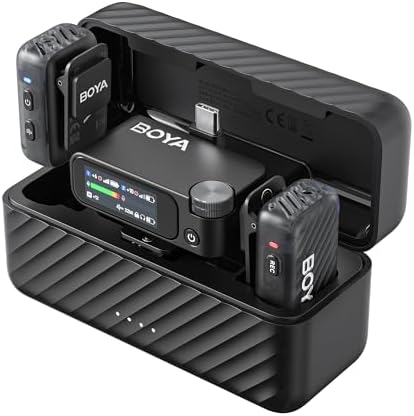
- Studio-Quality Sound: BOYAMIC2 wireless lavalier microphone supports 48kHz/24bit (default) and 48kHz/32bit (optional) hi…
- AI Noise Reduction: BOYAMIC 2 mini microphone uses advanced AI algorithms to identify and isolate over 7 million ambient…
- Independent Recording with 8G Memory: BOAYMIC 2 microphone for iPhone comes with 8GB storage space, which allows you to …
Overview of Rode Wireless Pro
The Rode Wireless Pro is an advanced wireless audio solution, specifically designed to meet the needs of content creators, filmmakers, and audio professionals. It offers a range of features that cater to various recording environments, ensuring exceptional audio fidelity and user-friendly operation. One of the standout aspects of the Rode Wireless Pro is its high-quality audio capture capability, which employs Rode’s patented technology. This results in a robust sound profile that is both clear and rich, making it suitable for both dialogue and ambient sounds.
This wireless system operates on the 2.4GHz frequency range, providing a reliable connection with minimal interference. It supports a substantial operating range, allowing users to capture audio from a distance without compromising sound quality. The Rode Wireless Pro is equipped with onboard controls that enable quick adjustments and settings customization, enhancing its ease of use. Additionally, the product features a smart power management system, which extends battery life, allowing for longer recording sessions without the need for frequent recharges.
In terms of design, the Rode Wireless Pro is compact and lightweight, making it highly portable for on-the-go recording. Its intuitive interface includes clear visual indicators for battery life and audio levels, which further simplifies the operating process. Performance in challenging environments, such as outdoor settings or crowded areas, is notable due to the system’s excellent noise rejection capabilities. Additionally, the Rode Wireless Pro includes useful accessories, such as a windscreen and a carrying case, enhancing its overall user experience. With its combination of performance, quality, and ease of use, the Rode Wireless Pro stands out as a leading choice in the competitive wireless audio market.
Audio Quality Comparison
When evaluating the audio quality of the DJI Mic 2 and the Rode Wireless Pro, several key factors come into play, including clarity, sound fidelity, frequency response, and the overall listening experience. Both microphones cater to professionals and enthusiasts alike, so understanding their performance can significantly influence buying decisions.
The DJI Mic 2 is renowned for its impressive clarity. It effectively captures crisp audio with minimal background noise, making it suitable for various applications such as vlogging, interviews, and music recordings. Users have reported a clean and rich sound, with excellent voice reproduction, which is crucial for maintaining the integrity of audio content. Furthermore, the built-in windshields help enhance the overall sound fidelity, reducing distortions caused by wind and external sounds.
On the other hand, the Rode Wireless Pro brings its own strengths to the table. It delivers robust sound fidelity and is particularly praised for its dynamic range. The microphone’s frequency response is quite wide, allowing it to pick up a more comprehensive array of frequencies, which can be beneficial for musicians and content creators looking for depth in their recordings. Users often highlight the warmth of the audio produced by the Rode Wireless Pro, attributing it to its superior engineering and design.
In terms of overall listening experience, both microphones perform admirably. The DJI Mic 2 tends to excel in environments where clarity is paramount, while the Rode Wireless Pro thrives in more dynamic settings where sound richness can shine. Ultimately, the choice between these models can come down to personal preference and specific use cases, as both offer commendable audio quality that satisfies a variety of professional needs.

- Compatible with Multiple Devices: This microphone comes with 3 adapter plugs, to adapt to most devices on the market, co…
- Sound Quality and Noise Reduction: We have upgraded and improved the microphone sound quality and noise reduction in all…
- Plug-Play and Auto Connect: Normally just 2 step to connect. Step 1: Plug the receiver into your device; Step 2: Power o…
Range and Connectivity
Wireless microphones have revolutionized the way audio is captured, and both the DJI Mic 2 and Rode Wireless Pro are prominent contenders in this space, particularly regarding their range and connectivity features. Understanding these factors is crucial for professionals seeking reliable performance across different recording environments.
The DJI Mic 2 boasts an impressive wireless range of up to 1,000 feet (approximately 300 meters) under optimal conditions. This robust range allows users to record sessions that require distance, such as interviews or performances across large spaces. The device employs frequency hopping technology which minimizes the risk of interference from other wireless devices, ensuring a clear audio signal consistently.
On the other hand, the Rode Wireless Pro offers a range of approximately 1,000 feet as well, but its standout feature is the ability to use digital transmission which provides higher audio fidelity. Designed for critical audio applications, it incorporates advanced wireless protocols and is sensitive to signal degradation. Like the DJI Mic 2, the Rode Wireless Pro also utilizes dynamic frequency selection, enabling it to navigate around busy wireless networks effectively.
In various recording scenarios, both microphones perform admirably; however, users may notice a difference during long-range recordings in environments with potential interference, such as urban landscapes or crowded venues. The Rode Wireless Pro seems marginally superior in maintaining audio quality under challenging conditions due to its adaptive technology. Nonetheless, the DJI Mic 2 remains a reliable option for those who prioritize simplicity and ease of use.
Ultimately, both devices cater to professional needs with their impressive ranges and connectivity options. The choice between them may hinge on specific recording requirements or personal preferences in terms of interface and additional features.
Battery Life and Charging Options
When evaluating wireless audio systems, the battery performance and charging capabilities are critical factors for users who often find themselves in dynamic field environments. The DJI Mic 2 and Rode Wireless Pro showcase distinct advantages in these areas, tailoring to the needs of audio professionals.
The DJI Mic 2 offers an impressive battery life, boasting up to 15 hours of recording time on a single charge. This longevity is crucial for extensive shoots or events where changing batteries may not be feasible. Furthermore, the device features a convenient charging case that not only protects the mics during transport but also extends their usage by providing additional charge cycles. Users can recharge the mics quickly, with an approximate charging time of two hours for a full battery.
On the other hand, the Rode Wireless Pro offers a comparable battery life, providing around 7 hours of continuous use, which is adequate for interviews and short film shoots. Notably, Rode’s system includes a USB-C charging option, permitting users to recharge their devices while in operation, ensuring uninterrupted audio capture. This can be particularly beneficial in scenarios where time is of the essence. It takes roughly 2.5 hours to achieve a full charge when using a power bank or wall charger.
Both systems also feature LED indicators displaying the battery status, thus allowing users to monitor power levels effectively during operation. In regard to power management, the DJI Mic 2 has automated power features that significantly conserve battery life when the mics are not in active use. Comparatively, Rode provides power-saving features that engage when the units are idle, although the specifics may vary based on the operational settings.
Ultimately, both the DJI Mic 2 and Rode Wireless Pro present competitive options, catering to various user needs concerning battery longevity and charging flexibility. Opting for either depends on the specific requirements of different audio environments.
User Experience and Usability
When comparing the DJI Mic 2 and the Rode Wireless Pro systems, user experience stands out as a critical component influencing overall satisfaction and effectiveness. Both audio systems strive to provide seamless installation processes and intuitive interfaces.
The installation of the DJI Mic 2 is notably straightforward, featuring a plug-and-play design that allows users to connect the devices quickly without extensive technical know-how. Its compact design and built-in clip enable easy attachment to clothing, thus facilitating a swift setup. The accompanying application, which offers customizable settings, further enhances usability, allowing novice users to navigate through various functionalities with ease.
In contrast, the Rode Wireless Pro system also prioritizes ease of use. It features a robust wireless connection that establishes promptly once the units are powered. The design incorporates a color display that provides clear visuals of the current settings, which can be adjusted via a user-friendly interface. This visual feedback is particularly beneficial for those who may not be technically inclined, helping prevent accidental misconfigurations.
In terms of functionality during recording sessions, the DJI Mic 2 delivers a remarkable user experience with its real-time monitoring capabilities. Users can easily check levels and adjust settings on-the-fly, which is especially valuable for dynamic recording environments. Conversely, the Rode system also offers real-time monitoring but adds an additional layer of sophistication with its advanced audio processing features, making it a favorable option for more experienced users or professionals seeking higher fidelity.
Both systems incorporate mobile applications for further optimization of audio settings and recording preferences. The DJI app focuses on simplicity, while Rode’s software caters to more detailed adjustments. Ultimately, while both systems deliver strong user experiences, the choice may depend on the specific needs of the user, particularly whether they prioritize ease of use or advanced features.

- 【Check Compatibility First】Works ONLY with karaoke machines, PA systems, amplifiers, and speakers with a MICROPHONE inpu…
- 【Professional Vocal Clarity】Cardioid pickup and DSP noise reduction reduce background noise and enhance vocal clarity fo…
- 【200ft Wireless Range】2.4GHz wireless technology provides up to 200ft (60m) range, allowing freedom of movement for kara…
Pricing and Value for Money
When it comes to the selection of audio equipment, pricing plays a crucial role in shaping consumer decisions. Both the DJI Mic 2 and Rode Wireless Pro offer a range of features aimed at diverse user needs, but their price points and overall value can vary significantly. Analyzing these elements helps potential buyers determine which option aligns better with their requirements and budget.
The DJI Mic 2 is priced competitively within the mid-range market, appealing to both amateur and semi-professional users. It offers robust features such as omnidirectional microphones, extensive wireless range, and user-friendly controls, all of which enhance its practicality. Given its affordable price tag, many find that the quality and performance of the DJI Mic 2 justify the investment, especially for those starting in video production or content creation.
Conversely, the Rode Wireless Pro tends to sit at a higher price point, targeted at professionals who demand superior audio fidelity and advanced functionalities. With features like dual-channel output, adjustable gain settings, and a broader frequency response, the Rode Wireless Pro is designed to cater to a more sophisticated user base. While its cost might seem steep for some, the exceptional sound quality and reliability underpinning this microphone can be viewed as a worthwhile investment for professionals dealing with critical audio application scenarios.
Competition in the market also introduces alternate options, making it essential for consumers to evaluate other wireless microphone systems. While considering alternatives, users should weigh the potential differences in audio quality, battery life, and overall ease of use. In conclusion, both the DJI Mic 2 and Rode Wireless Pro present their unique advantages at different price points, and determining which provides the best value for money will depend on individual preferences and specific audio needs.
- All-in-One, Universally Compatible – BOYALINK 2 wireless lavalier microphone features a 3-in-1 adapter (Lightning, USB-C…
- Enhanced Sensitivity – BOYAlink 2 lavalier microphone is equipped with a 6mm high-sensitivity tiny microphone for precis…
- Hi-Fi Sound, Studio-Grade Quality – With a 48kHz/24Bit audio format and 20Hz-20kHz frequency response, BOYALINK 2 mini m…
Conclusion and Recommendation
In assessing the DJI Mic 2 and Rode Wireless Pro, several key factors emerged that influence their suitability for different user profiles. Both wireless microphone systems offer exceptional audio quality, yet they cater to distinct needs within the realm of wireless audio.
The DJI Mic 2 is particularly well-suited for those who prioritize convenience and compactness. With its lightweight design and easy-to-use features, it is an excellent choice for casual content creators or vloggers who require mobility and simplicity without sacrificing sound quality. Its integration with various devices makes it an attractive option for on-the-go recordings, especially in dynamic environments.
Conversely, the Rode Wireless Pro caters to professional filmmakers who demand advanced functionality and versatility. Its robust features, including extended range and customizable settings, provide greater control over audio production in complex shooting scenarios. This system’s reliability and superior performance under challenging conditions make it indispensable for users who need to ensure high-quality sound in their cinematic endeavors.
Ultimately, the decision between the DJI Mic 2 and Rode Wireless Pro should align with the intended application and user expertise. Casual users may find the DJI Mic 2 more appealing due to its user-friendly interface, while seasoned professionals may benefit from the advanced capabilities of the Rode Wireless Pro. Each user’s unique requirements, whether for casual recording sessions or more demanding film productions, will guide their choice for optimal wireless audio solutions.
By understanding these distinctions, potential buyers can make an informed decision that best fits their audio needs, ensuring that their choice enhances their creative projects effectively.